Chasing in the Footsteps of My Hero - A Photo Expedition to the Teton Range
Some landscapes live in your imagination long before you ever stand in them.
For me, the Tetons are one of those places.
For decades I had studied the photographs that came from this valley - images that helped define the very language of landscape photography. The jagged skyline of the range. The winding path of the Snake River. The quiet valleys where light moves slowly across the land.
This is a place where photography history was written by those that came before me.
And for six days, I had the opportunity to walk into that history myself.
Long before sunrise each morning I would leave in the dark - driving through the silent valley as the first faint glow began to reveal the peaks. Coffee in hand. Camera gear packed. Watching the sky carefully the way landscape photographers always do - studying clouds, wind, and atmosphere, hoping the conditions might align while trying not to hit the elk or bison that roam freely across the valley.
Because that is the truth behind every photograph in places like this.
The image may last forever.
But the moment that creates it might only last seconds.
Daybreak in the Valley - Snake River Overlook
Standing Where Ansel Adams Once Stood
Some places carry a certain gravity for photographers.
Snake River Overlook is one of them.
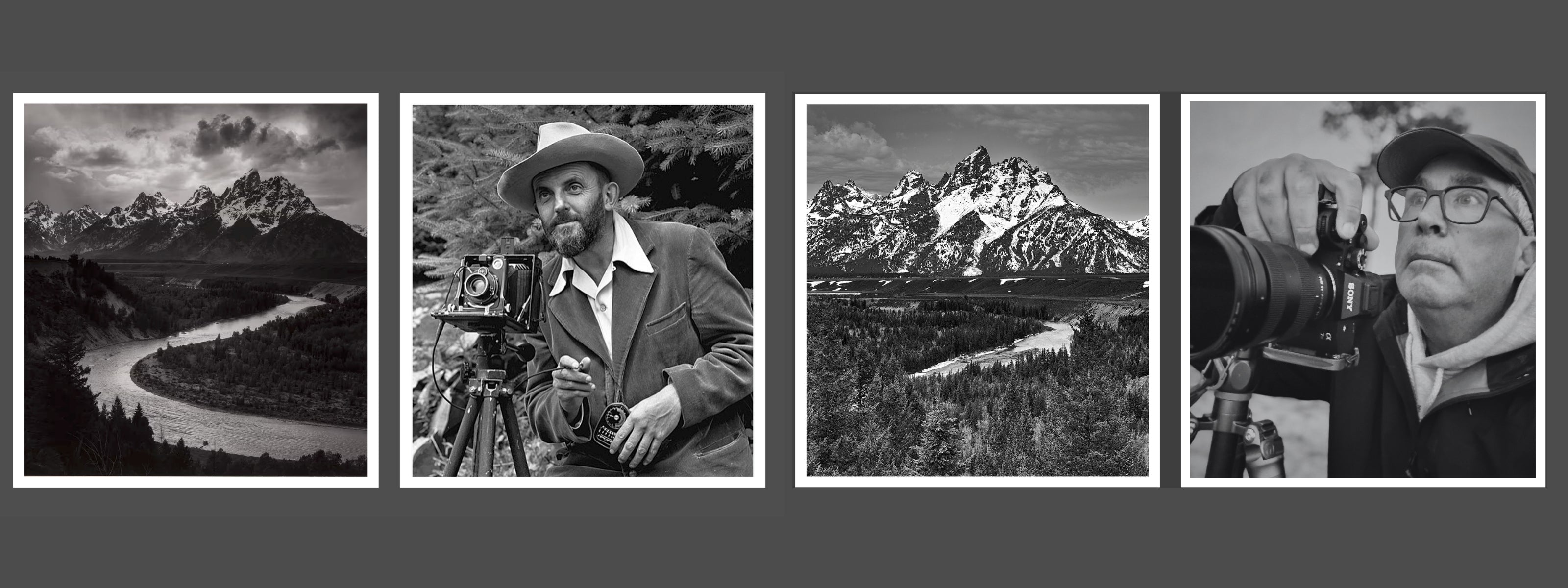
In 1942, Ansel Adams stood on this ridge and created what would become one of the most influential landscape photographs ever made - The Tetons and the Snake River. The image captured the Snake River winding through the valley beneath the dramatic peaks of the Teton Range and remains one of his most celebrated works. A print of this was on my wall growing up.
Standing there today, camera mounted on my trusty tripod, you immediately understand why the scene captivated him. The perfect composition of this place is hard to miss.
The valley stretches wide below you. The river winds quietly through the sagebrush flats. And beyond it all, the Tetons rise sharply into the sky, their jagged peaks catching the changing light as clouds drift across the range.
The landscape has evolved since Adams made his image. Trees have grown along the valley floor, partially obscuring the sweeping curve of the river that defined the original composition.
But the essence of the place remains.
Light still moves across the valley.
Clouds still gather and dissolve along the peaks.
And photographers still stand quietly along that ridge - watching, waiting for the moment when the landscape reveals itself.
Reflections of the Tetons - Schwabacher Landing
The Quiet Side of the Tetons
If Snake River Overlook is about scale and drama, Schwabacher Landing is about stillness.
Tucked along a quiet stretch of the Snake River, this location offers one of the most intimate views of the Teton Range. Calm channels along the river often create mirror-like reflections of the mountains rising above them.
Reaching the most iconic vantage point requires a short walk along the riverbank.
In the early hours before sunrise, the air often settles into complete stillness. The mountains appear suspended above the water, their reflection forming a second world beneath the surface.
You arrive in darkness, usually with a couple fellow light chasers. You set up quietly. And wait.
Then slowly, the first light touches the peaks as reflected in the images in my gallery.
The Tetons begin to glow while the water below reflects the same moment back toward the sky.
In places like this, photography becomes less about capturing an image and more about simply witnessing the moment.
Where History Meets the Mountains -Mormon Row
A Valley Shaped by People and Time
The Tetons are not only a wilderness landscape.
They are also a place shaped by the people who once tried to build lives beneath these towering peaks.
At Mormon Row, a small group of historic homesteads sits quietly in the open valley beneath the mountains. Weathered barns stand against the vast Wyoming sky while the Tetons rise dramatically behind them.
Two barns have become especially iconic for photographers—the T.A. Moulton Barn and the John Moulton Barn. Standing there at sunrise, the scene feels timeless.
Golden light begins to appear behind you sliding across the grasses of the valley floor. The barn anchors the foreground, worn and quiet from decades of wind and winter.
Behind it, the Tetons rise sharply into the sky.
It’s a composition that tells two stories at once.
The quiet determination of the people who once tried to settle this rugged valley.
And the immense landscape that surrounds it that greeted them on a daily basis.
Where the River Slows - Oxbow Bend
A Different Perspective of the Tetons
Further north along the Snake River lies one of the most peaceful locations in the park: Oxbow Bend.
Here the river curves into a wide, slow bend that reflects the surrounding landscape. From this vantage point, Mount Moran becomes the dominant peak in the composition rather than the Grand Teton.
Early mornings here feel almost meditative.
Mist sometimes drifts above the water as the sun begins to rise. The surface of the river moves slowly, reflecting the sky and mountain in soft layers of light.
Wildlife is often nearby - moose moving quietly through the willows, birds crossing the valley.
Compared to the dramatic sweep of Snake River Overlook, Oxbow Bend feels quieter.
More contemplative.
It’s a place where the landscape invites you to slow down and simply watch the light unfold.
Six Days of Chasing the Light
During my six days in the Tetons, I returned to these locations again and again.
Sunrise after sunrise.
Sunset after sunset.
Some mornings delivered quiet pastel skies. Others brought dramatic storms rolling across the mountains. Often the light never quite aligned the way you hoped it would.
That’s part of the pursuit.
Landscape photography isn’t about showing up once and capturing the scene. It’s about patience - returning to the same place, studying how the land responds to changing light, and waiting for the rare moment when everything falls into balance.
Those moments are never guaranteed.
But when they arrive, you feel it instantly.
Standing at Snake River Overlook one evening as the last light settled across the Tetons, I found myself thinking again about Ansel Adams.
Not about the photograph he made.
But about the experience he must have had standing in that same place—watching the sky, waiting for the light, knowing something extraordinary might unfold.
Decades later, photographers still come here for the same reason.
Not to chase someone else’s image.
But to chase the same light.
And when it finally arrives - even for a few fleeting seconds - you realize something remarkable.
The photograph is only part of the story.
The real reward is the moment itself.
Bringing the Tetons Home
The Tetons are one of those landscapes that stay with you long after you leave.
The scale of the mountains.
The quiet movement of the Snake River.
The way light reveals the peaks for just a few fleeting moments each morning and evening.
Each photograph from this expedition represents a moment when light, atmosphere, and place aligned in rare harmony.
Moments like these are fleeting in the wild.
But through fine art, they can live on.